

A Commercially Accessible Airborne Research Platform
AeroLabs is developing the ASCENT Airborne Science Program a commercially accessible airborne research capability based on the C-130J-30 Super Hercules, designed to support the broader scientific community with flexible, modular payload capacity and onboard research operations.
What is ASCENT?
ASCENT is a new model for accessing airborne science, research, technology validation and mission data without the cost and complexity of owning and operating dedicated aviation infrastructure. Developed by Space Centre Australia and delivered through AeroLabs LLC, ASCENT provides government agencies, universities, research institutions and industry partners with access to an integrated airborne mission capability. Rather than simply providing an aircraft, ASCENT brings together aviation, scientific payload integration, engineering, mission planning, flight operations, data collection, processing and mission support as a commercially accessible service. At the centre of ASCENT is a highly adaptable airborne platform designed around the C-130J-30 Super Hercules. Its combination of payload capacity, range, endurance, electrical power, mission flexibility and global deployability provides a foundation for a broad spectrum of scientific and technology missions. Modular payload architectures allow scientific instruments, remote-sensing systems, experimental technologies, communications equipment and other mission systems to be integrated according to individual program requirements.
Science Without Owning the Infrastructure Traditional airborne research programs can require significant investment in aircraft ownership, modification, engineering, certification, maintenance, specialist crews and supporting infrastructure before scientific operations can begin. For many universities, research teams and technology developers, these barriers can limit how frequently experiments can be flown or prevent promising concepts from reaching an operational environment. ASCENT changes this model.
Through Commercial Science as a Service, customers can procure the mission capability they require rather than establishing an aviation program of their own. AeroLabs can support the mission from initial concept and feasibility assessment through payload integration, engineering, flight planning, deployment, mission execution, data collection and post-mission support. This creates a pathway for researchers and technology developers to move from laboratory development to airborne experimentation, validation and operational deployment using shared, repeatable infrastructure.
ASCENT is Open for Mission Engagement
The ASCENT Commercial Science as a Service Program is currently progressing through platform establishment, mission development and early customer engagement. AeroLabs is now inviting U.S. Government agencies, universities, research institutions, aerospace companies, technology developers and commercial partners to register their interest in accessing ASCENT for future airborne science, technology demonstration, research and specialist mission requirements. Organizations do not need to have a fully developed flight program to engage with ASCENT. Researchers and mission teams can register at an early stage with a scientific objective, proposed instrument, technology, payload concept or future research requirement. AeroLabs can then work collaboratively with prospective users to understand the mission, assess potential platform compatibility and identify an appropriate pathway toward a future flight campaign. Build Your Mission Pipeline Early Early registration is intended to help AeroLabs develop the ASCENT mission pipeline while giving prospective users an opportunity to begin planning for future platform access. Registered organizations can identify anticipated mission requirements, payload characteristics, preferred operating locations, research objectives and indicative flight schedules before making a commitment to a full mission campaign. This allows AeroLabs to identify compatible missions, develop future flight campaigns and explore opportunities for shared deployments where multiple research teams may benefit from common aircraft positioning, operating areas or mission infrastructure. For universities and research organizations, early engagement can also support the development of future research proposals, grant applications and funding submissions by providing a defined pathway toward airborne access. Register → Discuss → Define → Integrate → Fly → Deliver Who Should Register? ASCENT registration is open to organizations considering current or future requirements across Earth Science, Heliophysics, Atmospheric Science, Astrophysics, Airborne Astronomy, Planetary Science, Remote Sensing, Environmental Monitoring, Technology Demonstration, Flight Testing and TRL Advancement. Become an Early ASCENT User The early development of ASCENT provides an opportunity for prospective users to help shape future mission capabilities and identify the aircraft, payload, data and operational requirements most valuable to the scientific community. Early engagement also allows AeroLabs to begin identifying potential mission clusters and future campaign opportunities across the United States and internationally. Whether your requirement is a single experimental payload, a university research campaign, validation of a new aerospace technology, recurring scientific observations or a long-term government research program, we encourage you to start the conversation now. Register your mission interest today and begin developing your pathway to flight with ASCENT. No Flight-Ready Payload Required You don't need to be ready to fly. If you have a research objective, instrument concept, technology requiring airborne validation or an anticipated future mission requirement, register your interest and tell us what you are trying to achieve. AeroLabs can help determine what comes next.
Discuss Your RequirementsC-130J-30 Super Hercules
The C-130J-30 is the stretched variant of the C-130J Super Hercules — the world's most capable tactical transport aircraft. The extended fuselage provides a large, pressurised cabin suitable for scientific payload integration, onboard researchers, and mission systems. Combined with the C-130J's range, endurance, and operational flexibility, the C-130J-30 provides an exceptional foundation for an airborne science platform.
ASCENT Science Capabilities
Modular Scientific Payloads
ASCENT is designed around a modular payload architecture — enabling rapid integration and removal of scientific instruments, sensors, and systems. Multiple payloads can be operated simultaneously, supporting multi-discipline campaigns and collaborative research missions.
Telescope & Optical Systems
The ASCENT platform is being designed to support telescope systems and optical instruments for heliophysics, astrophysics, and earth observation — including stabilised mounts, aperture access, and the thermal and vibration management required for precision optical science.
Onboard Researchers & Mission Specialists
The pressurised C-130J-30 cabin enables onboard researchers and mission specialists to operate instruments, monitor data, and respond to mission events in real time — a capability not available on unmanned or remotely operated platforms.
Secure Communications & Telemetry
ASCENT will provide secure communications and telemetry capability — enabling real-time data downlink, mission coordination with ground teams, and secure communications for government and sensitive research programs.
Onboard Data Processing
Onboard data processing capability enables real-time analysis, quality monitoring, and preliminary data products during flight — reducing post-mission processing time and enabling adaptive mission management based on in-flight results.
Multi-Discipline Campaign Support
ASCENT's modular architecture and large cabin enable simultaneous support for multiple scientific disciplines in a single campaign — maximising research value per flight hour and enabling collaborative multi-institution missions.
Commercial Access for the Science Community
ASCENT is being developed as a commercially accessible platform — available to universities, research institutions, U.S. Government agencies, and commercial science programs through mission contracts and campaign agreements. AeroLabs provides the aircraft, crew, mission integration, and operational support; researchers bring their instruments and science objectives.

Payload Integration
Modular, flexible payload architecture for multi-discipline campaigns
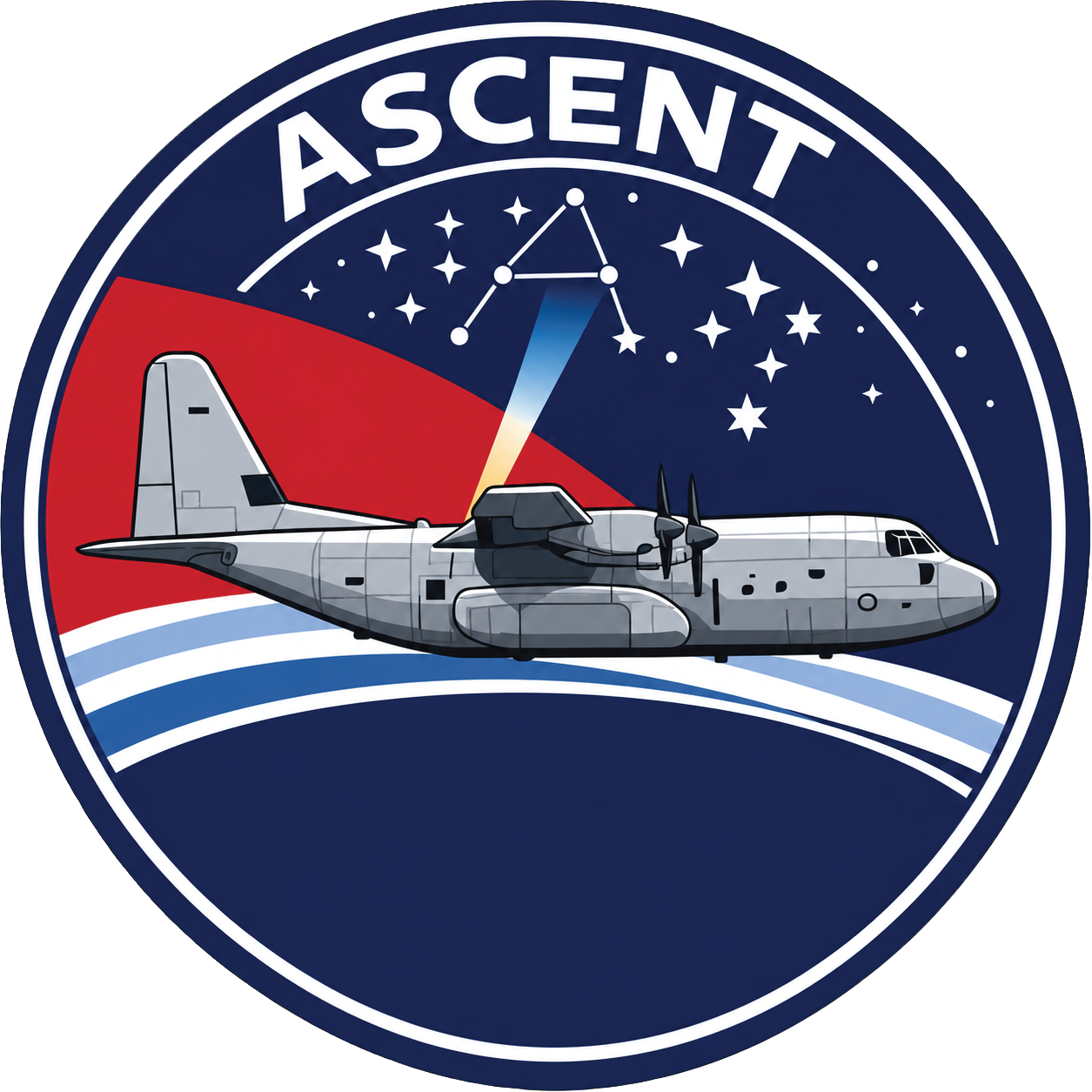
ASCENT Program — Mission Insignia
Future Aircraft Platform Acquisitions
AeroLabs is actively evaluating additional aircraft platforms to expand the ASCENT program's operational envelope enabling shorter-range, lower-altitude, and more agile science campaigns alongside the C-130J-30.
Beechcraft B200 King Air
Medium-Altitude Science Platform
The B200 King Air is under evaluation as a versatile medium-altitude research platform. Its twin-turboprop efficiency, pressurised cabin, and wide operator network make it well-suited to atmospheric sampling, sensor calibration flights, and regional science campaigns requiring rapid deployment.
Pilatus PC-12 NGX
Single-Engine Utility Science Platform
The PC-12 NGX is being assessed for its exceptional range, unprepared-strip capability, and large cargo door making it ideal for remote-area science deployments, sensor ferry missions, and campaigns requiring access to austere or high-altitude airstrips that larger platforms cannot service.
Platform Acquisition Status: Both the B200 King Air and PC-12 NGX are currently under evaluation as future ASCENT program platforms and airborne ligistics missions. Specifications and roles are indicative and subject to change as the acquisition process progresses. Contact AeroLabs to discuss specific mission requirements.
Partner with ASCENT
Contact AeroLabs to discuss your research requirements, payload concept, or interest in partnering with the ASCENT Airborne Science Program.